We'd like to use Google Analytics and Microsoft Clarity cookies to see how people use Scale & Fin, so we can improve it.
They stay off unless you allow them. Privacy
How to tie the Palomar, the improved clinch and the uni knot, step by step, with a card for each to print for the tackle box. We add a knot only when we can cite written steps for it.
Tie it, step by step
Palomar knot
Tie it at home first, so it comes easy on a cold bank.
Ties the line to a hook, a lure or a swivel, and is easy enough to tie with cold hands.
Double 20 to 30 cm (8 to 12 in) of line into a loop and pass the loop through the eye of the hook, lure or swivel.
Tie a very loose overhand knot with the doubled loop and the doubled line that runs back to the rod.
Pass the hook, lure or swivel through the loop that is left, and slide the loop up the line to just above the eye.
Wet the knot, then pull the tag end and the main line evenly to snug it down.
Trim the spare end to about 3 mm.
To undo it: Cut it off. A snugged Palomar is not meant to be untied.
Mind: The loop has to pass over whatever you are tying on, so it suits hooks and small lures better than big ones.
The Palomar ties line to a hook, a lure or a swivel. The Wikipedia article calls it strong and easy to tie, and says that with practice it can be tied in the dark with cold hands. It works when the thing you are tying on can pass through the loop, so it suits hooks, swivels and small lures.
A knot you trust means one less thing to think about on the bank.
The card
The button under each knot's steps makes an A4 card for the tackle box, every step on it. Set the printer to no scaling; the ruled line at the bottom of the card is 50 mm when it has come out true. Clubs can run off copies for a junior day, perhaps with the junior catch card.
The improved clinch and the uni
Animated Knots calls the improved clinch an angler's reliable standby for tying line to a hook, a lure or a swivel, and says fly anglers use it to tie the leader to the fly. Its extra tuck under the last turn is the improvement. It is harder to tie in heavy line, so the site doesn't recommend it for line over 30 lb test.
The uni knot is also known as the grinner, and as the Duncan knot after Norman Duncan, who invented it. Animated Knots says it works with braid and with nylon monofilament, and with practice can be tied in the dark.
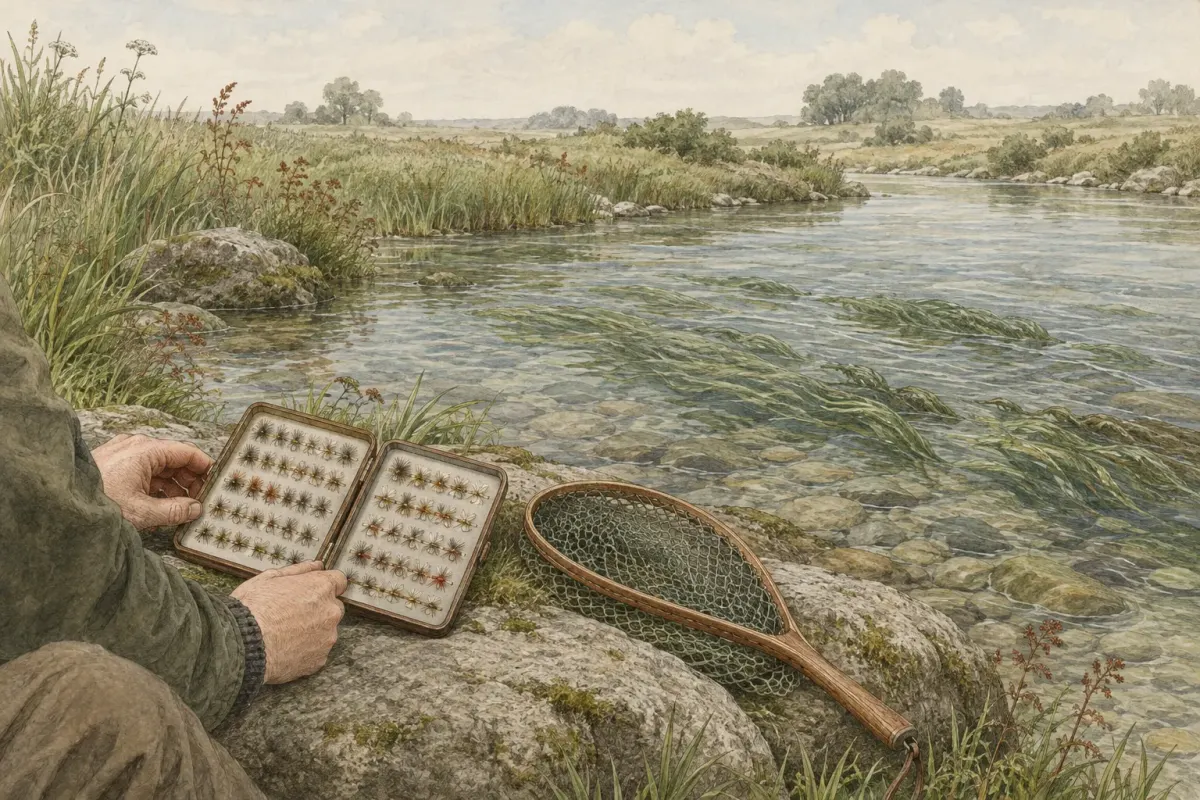
Fly anglers tie the leader to the fly with an improved clinch.
Where the steps come from
We teach a knot only once written steps from a source we can cite back it up, and we put those steps in our own words. A wrong step in a knot loses fish. The Palomar steps are from its Wikipedia article; the improved clinch and uni steps are from Animated Knots. All were read on 30 October 2026.
Written by Craig Fearn, Scale & Fin. Last updated .
Craig Fearn runs Scale & Fin, a UK studio that prints anglers' catch photos and fish art to order. He writes the guides here, and every fact in them links to the body that published it.
Questions, answered
How much line do I need for a Palomar knot?
Double 20 to 30 cm (8 to 12 in) of line into a loop to start.
How short do I trim the end of a Palomar?
To about 3 mm, once the knot is pulled tight.
What is a grinner knot?
Another name for the uni knot, also called the Duncan knot. It ties on hooks, swivels and lures, and two of them tied round each other join two lines.
How many turns for an improved clinch knot?
About five. Animated Knots says that with heavier line this may come down to four.